
 By Olivia Wilson Media Team
You have a website. You publish content. You have even built some backlinks. But your pages still sit on page two or three of Google, and your organic traffic barely moves month after month. The problem is often not your content quality or your link profile. The problem is hiding inside your website’s code, structure, and page-level signals.
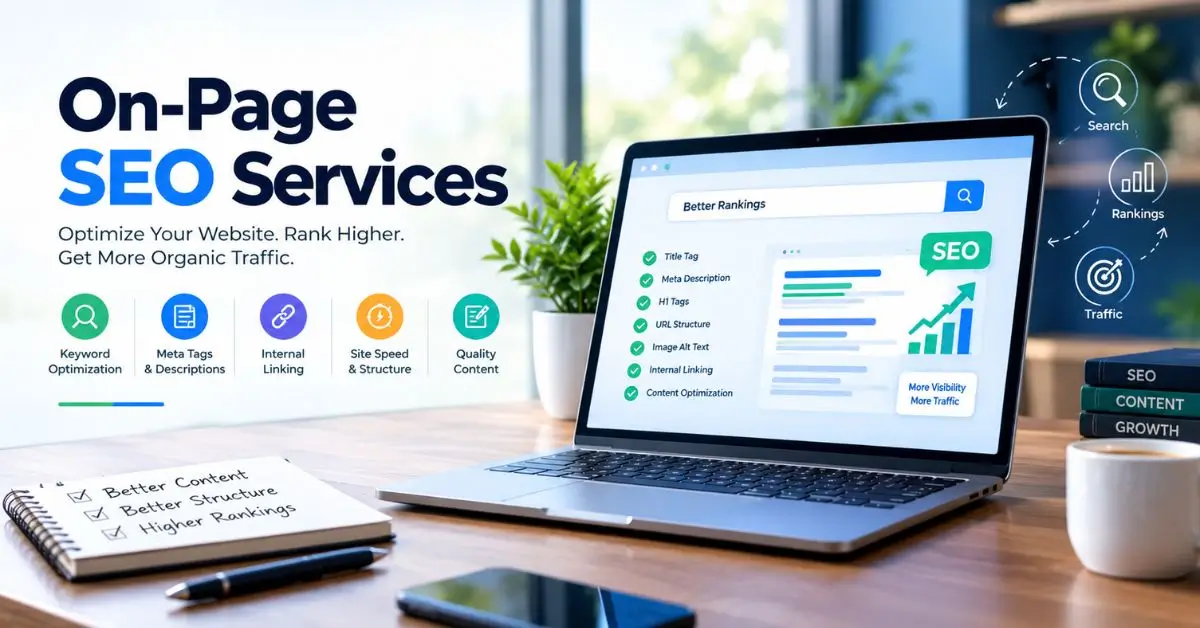
On-page SEO services are professional website optimization strategies that focus on improving individual web pages to rank higher in search engine results. These services include optimizing title tags, meta descriptions, heading structures, internal links, URL formats, image attributes, content relevance, and technical page elements that directly influence how search engines understand and rank your website.
In this guide, you will learn exactly what these services cover, which elements have the biggest impact on rankings, what mistakes to avoid, and how to decide whether to handle on-page optimization yourself or work with a professional.
On-page SEO services improve the elements on your actual web pages that search engines read and evaluate. The core work includes fixing title tags, meta descriptions, heading hierarchy, internal linking, URL structure, image optimization, content alignment with search intent, and page speed factors. Done correctly, these improvements help your pages rank higher, attract more qualified traffic, and convert more visitors into customers.
Think of your website like a house. Off-page SEO (backlinks, brand mentions, social signals) is like the neighborhood reputation. Technical SEO is the plumbing and electrical wiring. On-page optimization is the interior design, the room layout, and the signage that tells visitors exactly where they are and what each room offers.
If the interior is confusing, poorly labeled, and hard to navigate, it does not matter how great the neighborhood is. Visitors will leave quickly, and search engines will notice.
Google’s algorithms evaluate hundreds of on-page signals to determine what each page is about and whether it deserves to rank for a specific search query. When those signals are weak, contradictory, or missing entirely, your pages struggle to compete even if your content is genuinely excellent.
This is why professional on-page SEO services often deliver the fastest measurable improvements. You are fixing the signals that search engines read directly on your pages, and those fixes can start showing results within weeks rather than months.
Understanding what goes into on-page work helps you evaluate service providers and set realistic expectations. Here are the main elements that matter most.
Your title tag is the clickable headline that appears in search results. It is one of the strongest on-page ranking signals Google uses. A well-written title tag includes your target keyword near the beginning, stays under 60 characters, and clearly tells the searcher what the page offers.
Your meta description does not directly affect rankings, but it strongly influences click-through rates. A compelling meta description acts like a short advertisement that convinces searchers to click your result instead of a competitor’s.
For example, a page targeting “emergency plumber in Denver” should have a title like “Emergency Plumber in Denver | 24/7 Fast Response” rather than a generic “Home | Smith Plumbing Services.”
Headings organize your content for both readers and search engines. Your H1 tag should clearly state the main topic of the page and include your primary keyword. Subheadings (H2, H3) should break the content into logical sections that make the page easy to scan.
A common mistake is using multiple H1 tags on a single page or skipping heading levels entirely. Search engines use heading hierarchy to understand the structure and importance of your content. A clean, logical heading structure makes that job easier.
Content is still the most important on-page factor, but quality alone is not enough. Your content must match the search intent behind the keyword you are targeting.
If someone searches “best running shoes for flat feet,” they want a comparison guide with specific product recommendations. They do not want a 3,000-word history of shoemaking. Pages that fail to match search intent rarely rank well, no matter how well-written they are.
Professional on-page optimization includes analyzing the top-ranking pages for your target keywords, identifying the content format and depth that Google rewards, and adjusting your pages to meet or exceed those standards.
Internal links connect your pages to each other and help search engines discover and understand your site structure. They also pass authority from your strongest pages to pages that need a ranking boost.
A strong internal linking strategy includes:
- Linking from high-authority pages (like your homepage or popular blog posts) to important service or product pages
- Using descriptive anchor text that tells search engines what the linked page is about
- Ensuring every important page is reachable within two or three clicks from the homepage
- Removing or updating broken internal links that create dead ends
Many websites have hundreds of pages but almost no strategic internal linking. Fixing this alone can produce noticeable ranking improvements.
Clean, descriptive URLs help both users and search engines understand what a page is about before they even open it. A URL like “yoursite.com/services/residential-roofing-repair” is far more informative than “yoursite.com/page?id=3847.”
Best practices include keeping URLs short, using hyphens to separate words, including your target keyword when natural, and avoiding unnecessary parameters or session IDs.
Images often represent the largest files on a web page, and unoptimized images are one of the most common causes of slow page loading. Slow pages rank lower and lose visitors.
On-page image optimization includes:
- Compressing image file sizes without losing visible quality
- Using modern formats like WebP instead of heavy PNG files
- Adding descriptive alt text that explains the image content for accessibility and search engines
- Using descriptive file names instead of generic names like “IMG_4829.jpg”
Schema markup is code that you add to your web pages to help search engines understand specific types of content. It can trigger rich results in search listings, such as star ratings, FAQ dropdowns, product prices, and event dates.
While schema is not a direct ranking factor, rich results significantly improve click-through rates by making your listing more visually prominent on the search results page.
Even experienced website owners make errors that quietly undermine their search visibility. Here are the most frequent problems that on-page SEO services typically fix.
Keyword stuffing in title tags and content. Cramming your target keyword into every heading, paragraph, and image alt text does not help your rankings. It makes your content unreadable and can trigger search engine penalties. Use keywords naturally and focus on covering the topic thoroughly.
Duplicate title tags across multiple pages. If ten pages on your site all share the same title tag, Google struggles to determine which page should rank for which query. Every page needs a unique, descriptive title.
Thin or outdated content. Pages with fewer than 300 words of useful information rarely rank for competitive keywords. Similarly, content that has not been updated in several years may contain outdated facts that reduce its credibility.
Missing or generic meta descriptions. When you leave the meta description blank, Google pulls random text from your page. This often results in a confusing snippet that does not encourage clicks.
No mobile optimization. Google uses mobile-first indexing, which means it primarily evaluates the mobile version of your website. If your pages look broken or load slowly on phones, your rankings will suffer regardless of how good your desktop version looks.
Should you handle on-page optimization yourself or invest in professional on-page SEO services? The right answer depends on your technical comfort level, the size of your website, and how competitive your industry is.
| Factor | DIY On-Page Optimization | Professional On-Page SEO Services |
|---|---|---|
| Cost | Free or low-cost tools only | Monthly or project-based fee |
| Time Required | Several hours per week | Minimal time from your side |
| Technical Skill Needed | Moderate to high | Handled by the provider |
| Speed of Results | Slower due to learning curve | Faster with experienced execution |
| Audit Depth | Surface-level with free tools | Comprehensive with premium tools |
| Ongoing Maintenance | Your responsibility entirely | Typically included in the service |
| Best For | Small sites with under 20 pages | Larger sites or competitive niches |
If you run a small personal blog or a simple portfolio site, you can likely handle basic on-page fixes yourself using free tools like Google Search Console and browser extensions. However, if you operate a business website with dozens or hundreds of pages in a competitive market, professional help usually delivers a much stronger return on investment.
Consider a mid-size law firm in Chicago that was getting very little organic traffic despite having a well-designed website and a strong reputation in the local community.
An on-page audit revealed several critical issues:
- 34 pages had duplicate or missing title tags
- Service pages had thin content averaging only 200 words each
- Internal linking was almost nonexistent between practice area pages
- Images were uncompressed, causing page load times over six seconds on mobile
- No schema markup was present on any page
After a focused on-page optimization project that addressed all of these issues, the firm saw a 45 percent increase in organic traffic within three months. Their main practice area pages moved from page two to the top five results for several competitive local keywords. The firm did not build a single new backlink during that period. All improvements came from fixing on-page elements.
On-page optimization is not the flashiest part of search engine marketing, but it is the part you have the most control over. Every title tag you improve, every heading you restructure, and every slow image you compress sends a clearer signal to search engines about what your pages offer.
Whether you decide to tackle these improvements yourself or partner with a knowledgeable provider, the most important step is to stop leaving these ranking signals on the table. Your competitors are already optimizing their pages. The longer you wait, the harder it becomes to catch up.
If you want a clear, honest assessment of your website’s on-page health and specific recommendations tailored to your business goals, feel free to reach out through ahmadwithseo.com for a practical consultation.
On-page SEO services include optimizing title tags, meta descriptions, heading structures, URL formats, internal links, image attributes, content relevance, and schema markup on your individual web pages. The goal is to make each page clearly understandable to search engines and highly relevant to specific search queries.
Most websites start seeing ranking improvements within two to six weeks after on-page fixes are implemented and re-crawled by search engines. Competitive keywords may take longer. Full results across all optimized pages typically develop over two to four months of consistent effort.
Pricing varies based on the size of your website and the depth of work required. A one-time on-page audit and optimization for a small business site typically ranges from $500 to $2,500. Ongoing monthly optimization for larger sites usually falls between $1,000 and $3,000 per month depending on scope.
Yes, you can handle basic on-page optimization yourself if you are comfortable editing your website. Start by fixing title tags, writing unique meta descriptions, improving heading structures, and compressing images. Free tools like Google Search Console and PageSpeed Insights can guide your efforts.
Both matter, but on-page optimization is the foundation. Without strong on-page signals, even high-quality backlinks will not push your pages to the top of search results. Think of on-page work as preparing your pages to rank and backlinks as the fuel that accelerates that ranking.
No, on-page optimization is an ongoing process. Search algorithms change, competitor pages improve, and your own content grows over time. Regular audits every six to twelve months help you catch new issues, update outdated content, and maintain strong rankings as your website evolves.