
 By Olivia Wilson Media Team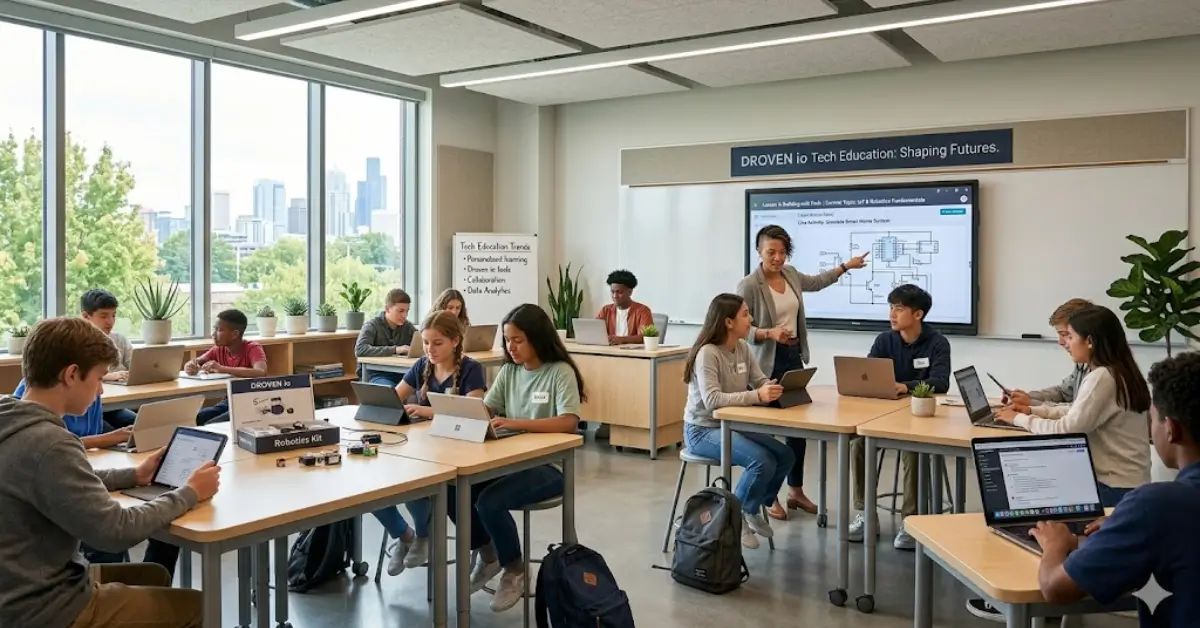
The landscape of education has undergone remarkable transformation in recent years, with technology becoming an inseparable part of how we teach and learn. The droven io tech education trends represent the cutting edge of this evolution, combining innovative digital tools with proven pedagogical methods to create more effective learning experiences. These trends are reshaping everything from elementary classrooms to corporate training programs across the United States, United Kingdom, and Canada.
Educational technology has moved far beyond simple computer labs and basic software. Today’s droven io tech education trends encompass artificial intelligence tutors, virtual reality field trips, adaptive learning platforms, and collaborative tools that connect learners across continents. Understanding these trends is essential for educators, administrators, parents, and students who want to stay ahead in an increasingly digital world.
The emergence of platforms and methodologies associated with droven io tech education trends reflects a fundamental shift in educational philosophy. Rather than viewing technology as merely a supplement to traditional teaching, forward-thinking educators now recognize it as a powerful catalyst for reimagining how learning happens. This perspective opens doors to personalized instruction, global collaboration, and learning experiences that were impossible just a decade ago.
Artificial intelligence stands at the forefront of droven io tech education trends, fundamentally changing how educational content is delivered and assessed. AI-powered systems can now analyze student performance in real-time, identifying knowledge gaps and adapting instruction to meet individual needs. These intelligent systems work alongside teachers, handling routine assessments and administrative tasks while freeing educators to focus on meaningful student interactions.
The application of AI in education extends beyond simple automation. Machine learning algorithms can predict which students might struggle with upcoming concepts based on their performance patterns, allowing for proactive intervention. Natural language processing enables conversational AI tutors that can answer student questions at any time, providing support outside traditional classroom hours. This technology democratizes access to personalized attention that was previously available only to students with private tutors.
Educational institutions implementing AI-driven solutions report significant improvements in student engagement and outcomes. The technology excels at maintaining student motivation through carefully calibrated challenges that are neither too easy nor frustratingly difficult. By continuously adjusting to each learner’s pace and style, AI systems embody the droven io tech education trends philosophy of meeting students where they are and guiding them forward from that point.
Among the most impactful droven io tech education trends is the movement toward truly personalized learning experiences. Traditional classroom instruction follows a one-size-fits-all approach that inevitably leaves some students bored while others struggle to keep up. Modern educational technology platforms create customized learning pathways that adapt to each student’s strengths, weaknesses, interests, and learning preferences.
These personalized systems track hundreds of data points about how individual students interact with content. They note which types of explanations resonate best, whether a student learns better through visual or auditory input, and which times of day yield the strongest focus. This granular understanding allows the technology to present information in ways that maximize comprehension and retention for each unique learner.
The implementation of personalized learning represents more than just technological advancement; it reflects a philosophical commitment to treating students as individuals rather than standardized units. Teachers using these systems report being able to provide more targeted support because the technology handles the heavy lifting of content delivery and initial assessment. Students benefit from instruction that respects their individual journey while still maintaining rigorous academic standards.
The integration of virtual reality and augmented reality into education represents one of the most exciting droven io tech education trends. These immersive technologies transport students to places and times that would otherwise be inaccessible. History students can walk through ancient Rome, biology students can explore the human circulatory system from inside a blood vessel, and engineering students can disassemble complex machinery without expensive physical models.
Virtual reality creates completely immersive digital environments that engage multiple senses simultaneously, leading to deeper learning and better retention. Studies show that students remember significantly more information when they experience it through VR compared to reading about it or watching videos. The emotional impact of feeling present in a historical event or scientific phenomenon creates memorable learning moments that traditional methods cannot replicate.
Augmented reality overlays digital information onto the physical world, creating hybrid learning experiences that blend real and virtual elements. Students might point their tablets at a textbook page and see 3D models spring to life, or walk around their school campus while their devices provide historical information about each location. These applications of droven io tech education trends make abstract concepts tangible and bring excitement to subjects that students previously found dry or difficult.
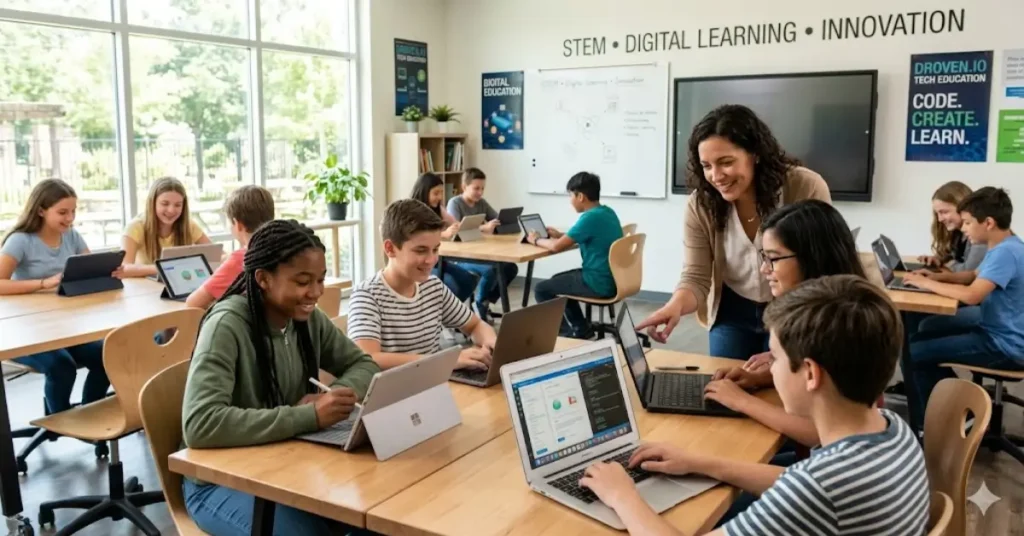
Modern educational technology emphasizes connection and collaboration, breaking down the walls of traditional classrooms. The droven io tech education trends include sophisticated platforms that enable students from different countries to work together on projects, sharing perspectives and cultural insights while developing crucial collaboration skills. These tools prepare students for a globalized workforce where remote teamwork is increasingly common.
Cloud-based collaborative platforms allow multiple students to work simultaneously on documents, presentations, and projects. Teachers can observe this collaboration in real-time, providing guidance and assessment throughout the creative process rather than only evaluating finished products. This shift from product-focused to process-focused learning gives educators better insight into student thinking and provides more opportunities for meaningful intervention.
The social dimension of learning receives renewed emphasis through these collaborative technologies. Discussion forums, video conferencing, peer review systems, and shared digital workspaces create communities of learners who support each other’s growth. Students develop communication skills, learn to give and receive constructive feedback, and experience the diversity of thought that emerges when people from different backgrounds tackle problems together.
Data analytics has emerged as a cornerstone of droven io tech education trends, providing educators and administrators with unprecedented insight into learning processes and outcomes. Educational platforms now generate detailed reports about student engagement, comprehension, and progress. These analytics help teachers identify which instructional strategies work best and which students need additional support before they fall significantly behind.
Learning analytics goes beyond simple grade tracking to examine the nuances of how students interact with educational content. The technology can reveal that a student spent considerable time on a particular concept, attempted multiple practice problems, and consulted additional resources, all of which indicate engagement even if the final assessment score doesn’t fully reflect that effort. This deeper understanding enables more nuanced and fair evaluation.
Schools and districts use aggregated data to make informed decisions about curriculum, resource allocation, and professional development. When data shows that students consistently struggle with particular concepts or that certain teaching methods yield better results, administrators can respond with targeted interventions and support. This evidence-based approach to educational improvement represents a significant advancement over intuition-based decision making.
The proliferation of smartphones and tablets has enabled learning to break free from fixed locations and scheduled times. Mobile learning represents a crucial aspect of droven io tech education trends, acknowledging that education increasingly happens everywhere, not just in designated classroom spaces. Students can review materials during commutes, complete assignments from coffee shops, and access educational resources from virtually anywhere with internet connectivity.
Educational apps designed for mobile devices offer bite-sized learning experiences perfect for busy schedules and short attention spans. Microlearning modules deliver focused content in five to ten minute sessions that students can complete during brief free moments throughout their day. This approach aligns with how people actually use mobile devices and recognizes that learning doesn’t require hour-long uninterrupted sessions to be effective.
Mobile technology also addresses equity concerns by providing educational access to students who may not have computers at home but do have smartphones. While not a complete solution to the digital divide, mobile-optimized educational content ensures that more students can participate in technology-enhanced learning regardless of their economic circumstances. This democratization of access is central to the inclusive vision underlying droven io tech education trends.
Incorporating game design elements into educational experiences has proven remarkably effective at boosting student motivation and engagement. The droven io tech education trends embrace gamification strategies that transform learning from an obligation into an enjoyable challenge. Points, badges, leaderboards, progress bars, and narrative frameworks tap into the same psychological rewards that make games compelling while directing that engagement toward educational goals.
Well-designed gamified learning experiences maintain careful balance between competition and collaboration, challenge and support. Students earn recognition for achievements and can see their progress visualized in satisfying ways. The immediate feedback inherent in game mechanics helps learners understand exactly what they’ve mastered and what requires more attention, promoting metacognitive awareness of their own learning process.
Critics sometimes dismiss gamification as superficial, but research increasingly supports its effectiveness when implemented thoughtfully. The key lies in ensuring that game elements enhance rather than distract from learning objectives. When students feel genuinely motivated to engage with challenging content because the experience is enjoyable and rewarding, gamification achieves its purpose of making education both effective and appealing.
As education becomes increasingly digital, the droven io tech education trends necessarily include emphasis on cybersecurity and responsible technology use. Students need to understand how to protect their personal information, recognize online threats, and navigate digital spaces safely. Educational institutions are integrating digital citizenship curricula that teach these essential skills alongside traditional academic subjects.
The importance of cybersecurity education extends beyond individual protection to encompass ethical considerations about online behavior. Students learn about digital footprints, the permanence of online actions, appropriate communication in digital spaces, and the responsibilities that come with technological power. These lessons prepare young people to be thoughtful participants in digital society rather than passive consumers or careless users.
Educational technology platforms themselves must prioritize student data protection and privacy. Schools implementing new tools carefully evaluate their security measures and data handling practices. The conversation around droven io tech education trends increasingly includes discussions about building student trust through transparent data practices and giving learners appropriate control over their educational information.
Looking ahead, the droven io tech education trends point toward even more sophisticated integration of technology and pedagogy. Emerging technologies like brain-computer interfaces, advanced AI tutors with emotional intelligence, and fully immersive metaverse classrooms are moving from science fiction to practical possibility. The next decade will likely see educational experiences that current teachers and students can barely imagine.
The continued evolution of educational technology will require ongoing adaptation from all stakeholders. Teachers will need professional development that goes beyond basic technology skills to address pedagogical integration and ethical considerations. Students will need to develop technological literacy that allows them to learn effectively in rapidly changing digital environments. Administrators and policymakers must create frameworks that encourage innovation while protecting student welfare.
Despite technological advancement, the human element of education remains irreplaceable. The most effective implementation of droven io tech education trends recognizes technology as a powerful tool that enhances but does not replace human teachers. The future of education lies in finding the optimal balance between technological efficiency and human connection, between standardized content delivery and personalized mentorship, between global access and local community.
Droven io tech education trends refer to new developments in educational technology like AI learning tools, virtual classrooms, and digital collaboration platforms.
AI is used for personalized learning, automated grading, student performance tracking, and adaptive study systems that adjust to individual needs.
It improves learning by adapting lessons to each student’s pace, strengths, and weaknesses instead of using a single teaching method for everyone.
VR creates immersive environments where students can explore and practice concepts in interactive, real-world simulations.
Data analytics helps teachers track progress, identify struggling students early, and improve teaching strategies based on real learning data.
The droven io tech education trends represent a fundamental transformation in how we approach teaching and learning in the digital age. From artificial intelligence that personalizes instruction to virtual reality that makes abstract concepts tangible, these technological innovations are creating educational experiences that were unimaginable just a generation ago. The integration of collaborative platforms, mobile learning, gamification, and data analytics is building an educational ecosystem that is more engaging, effective, and accessible than traditional methods alone.
As we move forward, the successful implementation of droven io tech education trends will require thoughtful balance between innovation and proven pedagogical principles. Technology should enhance rather than replace the human connections that make education meaningful. By embracing these trends while maintaining focus on student wellbeing, critical thinking, and genuine understanding, educators can harness technology’s power to create learning experiences that prepare students for a rapidly changing world while nurturing the timeless qualities of curiosity, creativity, and compassion that define human potential.